

November 2026 | Australian Property Market, Interest Rates, Inflation and Toowoomba Real Estate Outlook
2026 has been a year of significant change for the Australian property market. Rising interest rates, persistent inflation, affordability pressures and changing buyer confidence have reshaped the housing landscape. As we approach the end of November, the market is looking very different from where it started the year.
For homeowners, investors, buyers and sellers across Australia, including Toowoomba and the Darling Downs, the question is increasingly shifting from how much further can property prices rise? to what will drive the market in 2027?
Despite considerable economic uncertainty, the Australian property market continues to demonstrate the importance of local conditions. While higher borrowing costs have placed pressure on property values nationally, housing supply, population growth, employment opportunities and affordability remain important factors influencing individual markets.
We examine the major developments of 2026 so far, what has happened to interest rates and inflation, and what buyers, sellers and investors should be preparing for as we head into 2027.
1. Interest Rates: 2026 Has Delivered a Major Shift
RBA OFFICIAL CASH RATE — NOVEMBER 2026
4.85%
Source: Reserve Bank of Australia, November 2026 monetary policy decision.
One of the biggest influences on the property market during 2026 has been the Reserve Bank of Australia's return to interest rate increases.
After the easing cycle of 2025, hopes of sustained interest rate relief were challenged by inflation remaining above the RBA's target range.
By September, the official cash rate had reached 4.60%, following four increases during 2026. The RBA then increased rates by another 0.25 percentage points in November, taking the cash rate to 4.85%.
CommBank+1
The impact on households has been substantial.
Higher interest rates affect the property market in several ways:
-
Mortgage repayments increase: Households with variable-rate loans face higher monthly costs.
-
Borrowing capacity reduces: Buyers may qualify for smaller loans, affecting purchasing budgets.
-
Investor cash flow tightens: Higher interest expenses can reduce rental property profitability.
-
Buyer confidence changes: Uncertainty surrounding future interest rates can lead to more cautious purchasing decisions.
-
Property price growth moderates: Reduced borrowing capacity can limit the prices buyers are able to pay.
What do higher interest rates mean for mortgage repayments?
For a $700,000 principal-and-interest mortgage over 30 years, an illustrative increase in the loan interest rate from 6.00% to 7.25% would produce the following result:
At 6.00%
$4,197
Monthly repayment
At 7.25%
$4,775
Monthly repayment
That represents approximately $578 extra per month, or $6,936 annually, assuming the full interest rate increase is passed on.
The example illustrates why interest rates remain such an important factor in household budgets and property purchasing decisions.
2. Inflation: The Biggest Challenge Facing Australia's Economy
Inflation has remained a central economic issue throughout 2026.
While there had been optimism that inflation was moving sustainably towards the RBA's 2–3% target range, renewed price pressures have complicated that outlook.
The RBA's November assessment reported annual headline inflation of 3.9% for the September quarter, with trimmed mean inflation at 3.7%. The monthly CPI reading for September was higher, at 4.3% annually. These figures use different measurement periods and should not be directly compared as equivalent readings.
RBA+1
September 2026 inflation snapshot
4.3%
Monthly CPI annual rate
3.9%
Quarterly headline CPI annual rate
3.7%
Quarterly trimmed mean annual rate
Several factors have contributed to inflationary pressures, including elevated energy and transport costs, housing-related expenses and persistent price increases across services.
Global developments, particularly the conflict in the Middle East and its effect on energy prices, have also complicated Australia's inflation outlook.
Why does inflation matter for property?
Inflation influences much more than supermarket prices and household expenses.
For property owners and investors, inflation can increase maintenance expenses, insurance premiums, council rates and construction costs. These expenses can affect both the cost of holding existing properties and the financial viability of building new homes.
Higher construction costs can also restrict new housing supply, particularly when developers face additional financing costs.
The RBA's latest forecasts suggest inflation will remain above 3% until late 2027, with a return towards the midpoint of its target range expected in 2028.
RBA+1
This suggests the interest rate environment may remain challenging for longer than many households anticipated at the beginning of 2026.
3. Australian Property Prices: From Growth to Correction
The Australian property market has undergone a substantial change in direction during 2026.
Following several years of strong growth in many regions, higher interest rates and deteriorating affordability have contributed to a significant national correction.
According to Cotality's November Home Value Index, which reports October results:
-1.2%
National October change
-6.7%
National change since March peak
-8.1%
Capital cities over seven months
Source: Cotality Home Value Index, released 2 November 2026.
Cotality+1
Monthly percentage change in Cotality's Home Value Index.
-2.5%-1.875%-1.25%-0.625%0%BrisbanePerthSydneyAdelaideNationalMelbourne
The national decline is particularly significant because of its speed. Cotality reports that the combined capital cities have experienced their fastest seven-month decline in four decades.
However, falling prices do not automatically mean every property is experiencing the same level of correction.
Property type, location, condition, buyer demand and local supply remain important considerations.
Buyers are gaining negotiating power
One of the clearest changes has been the balance between buyers and sellers.
National home sales over the three months to October were approximately 23% lower than a year earlier, while the median selling period across the combined capital cities increased to 39 days.
More properties are remaining available for longer, and buyers are increasingly able to compare options, negotiate prices and complete their due diligence without the same urgency experienced during stronger market conditions.
Cotality+1
For sellers, this highlights the importance of realistic pricing, quality presentation and an effective marketing strategy.
4. Toowoomba Property Market: A Strong Year, but Conditions Are Changing
While the national housing market has weakened, Toowoomba entered the second half of 2026 following a period of particularly strong property price growth.
REIQ figures for the year ending June 2026 showed:
| Toowoomba property indicator | Result |
|---|---|
| Median house price, 12 months | $810,000 |
| Annual house price growth | +20.12% |
| Median unit price, 12 months | $615,500 |
| Annual unit price growth | +25.61% |
| September quarter rental vacancy | 0.6% |
Sources: REIQ quarterly market reporting and September vacancy data, as compiled in the November 2026 Toowoomba market review. These are historical sales medians, not current property valuations.
IPS Buyer's Agents
These results demonstrate the strength of Toowoomba's earlier market performance. However, they should not be interpreted as evidence that the same growth rates have continued into November.
More recent Cotality data shows regional Queensland dwelling values declined 2.7% over the three months to October 2026, indicating that the broader regional market is also experiencing the effects of higher interest rates and weaker demand.
IPS Buyer's Agents+1
What continues to support Toowoomba?
Several underlying factors remain relevant to the region's longer-term housing market.
Relative affordability: Compared with Brisbane and other major metropolitan markets, Toowoomba continues to offer different entry points for buyers, particularly across established residential suburbs and surrounding communities.
A diverse local economy: Healthcare, education, agriculture, logistics, construction and professional services contribute to the region's employment base.
Infrastructure investment: Major projects, including the new Toowoomba Hospital and transport infrastructure, may support employment and future demand, although the effect on individual property values is not guaranteed.
Limited rental availability: Toowoomba's rental vacancy rate of 0.6% in the September quarter indicates continued competition for available rental accommodation.
The key distinction heading into 2027 is that strong long-term fundamentals do not make a market immune to short-term price corrections.
For buyers and sellers in suburbs such as Highfields, Rangeville, Middle Ridge, Glenvale, Newtown and Gowrie Junction, recent comparable sales and current buyer activity will become increasingly important when determining market value.
5. Rental Market: Tight Supply Remains an Important Factor
Despite changing sales market conditions, rental accommodation remains an important part of Australia's housing challenge.
Toowoomba's low rental vacancy rate has continued to place pressure on tenants seeking suitable accommodation.
For example, Residential Tenancies Authority figures indicate that the median weekly rent for a three-bedroom house in postcode 4350 increased from $530 to $570 between the September quarters of 2025 and 2026.
IPS Buyer's Agents
For investors, this creates an interesting combination of circumstances.
Higher rental income can improve investment returns, but increased mortgage interest, insurance, maintenance and other ownership expenses may offset some or all of those gains.
As property values adjust, gross rental yields may become more attractive in some locations. However, investors should distinguish between gross rental returns and the actual cash flow remaining after expenses.
Looking towards 2027, rental demand may remain resilient where housing supply is constrained, although affordability pressures could limit further rental increases.
6. What Should We Expect From Interest Rates in 2027?
The outlook for interest rates has changed considerably throughout 2026.
At the beginning of the year, many households were hoping for lower borrowing costs. By November, the RBA was instead responding to inflation that had remained more persistent than anticipated.
The RBA's November forecasts indicate that inflation is expected to remain above its target range for much of 2027. The central bank also expects slower economic growth and a gradual rise in unemployment.
RBA
This creates three possible scenarios.
Scenario 1: Interest rates remain elevated
If inflation gradually moderates but remains above target, the RBA may maintain restrictive interest rates for an extended period. This would likely keep borrowing capacity constrained and property market conditions subdued.
Scenario 2: Further interest rate increases
If energy prices and domestic inflation remain elevated, additional rate increases remain possible. This would create further pressure on mortgage repayments and housing demand.
Scenario 3: Inflation eases faster than expected
If inflation falls more rapidly and economic activity weakens, the RBA may eventually have scope to reduce rates. Lower borrowing costs could help restore confidence and support housing demand.
These scenarios are possibilities rather than forecasts of specific decisions.
The RBA's current central outlook suggests that households should avoid relying on imminent interest rate cuts when making financial decisions.
7. Property Market Outlook for 2027: Five Trends to Watch
1. Price sensitivity will remain important
With borrowing capacity under pressure, buyers are likely to remain selective. Properties priced appropriately for their condition and location may continue to attract interest, while overpriced listings could experience longer selling periods.
2. Buyers may have more opportunities
A softer market can provide buyers with additional choice and negotiating power.
However, lower purchase prices must be weighed against higher borrowing costs, particularly for buyers requiring substantial finance.
3. Quality properties may outperform
Well-maintained homes, practical floor plans, energy efficiency and desirable locations may become increasingly important as buyers scrutinise value.
Properties requiring substantial renovation may face additional resistance where construction and trade costs remain elevated.
4. Investors will focus more closely on cash flow
The combination of higher interest rates and changing property values may encourage investors to place greater emphasis on rental yield, ongoing expenses, vacancy risk and long-term holding costs.
5. Local markets will become increasingly important
Broad national figures provide useful context, but property markets do not move uniformly.
Different suburbs, property types and price brackets can experience significantly different conditions. Understanding local supply, buyer demand and recent transactions will be essential throughout 2027.
8. What Does This Mean for Buyers, Sellers and Investors?
For buyers
The changing market may create opportunities to negotiate more favourable purchasing terms. Focus on affordability, finance approval, property condition and long-term suitability rather than attempting to predict the exact bottom of the market.
For sellers
Pricing and presentation will be critical. A property that is well marketed and accurately priced can still attract genuine buyers, but expectations should reflect current market evidence rather than peak prices achieved earlier in the cycle.
For investors
Review interest costs, rental income, maintenance requirements and the potential for future capital growth. Strong rental demand can be beneficial, but investments should remain financially sustainable if interest rates stay elevated.
9. Final Thoughts: 2026 Has Been a Year of Adjustment
As we approach the end of 2026, the Australian property market is entering a very different phase from the rapid growth experienced in previous years.
Interest rates have increased, inflation has remained stubbornly elevated, and national property values have recorded a substantial correction.
However, it is important to distinguish between short-term market conditions and the longer-term factors influencing housing demand.
Population growth, employment, infrastructure, housing supply and affordability will continue to shape property markets across Australia.
For Toowoomba and the Darling Downs, 2026 has delivered strong historical growth alongside increasing evidence of a changing market. The region's rental demand and diverse economic base remain relevant, but future price performance will depend on how these factors interact with interest rates, household budgets and buyer confidence.
Our expectation for 2027 is a more cautious, price-sensitive property market, where local knowledge, realistic expectations and sound financial decisions become increasingly valuable.
Whether buying, selling or investing, the focus should remain on individual circumstances and the fundamentals of each property rather than relying solely on national headlines.
At Tomoro, we continue to monitor the Toowoomba and Highfields property markets closely, helping property owners understand changing market conditions and make informed real estate decisions.
You might also be interested in
Oct 23, 2026
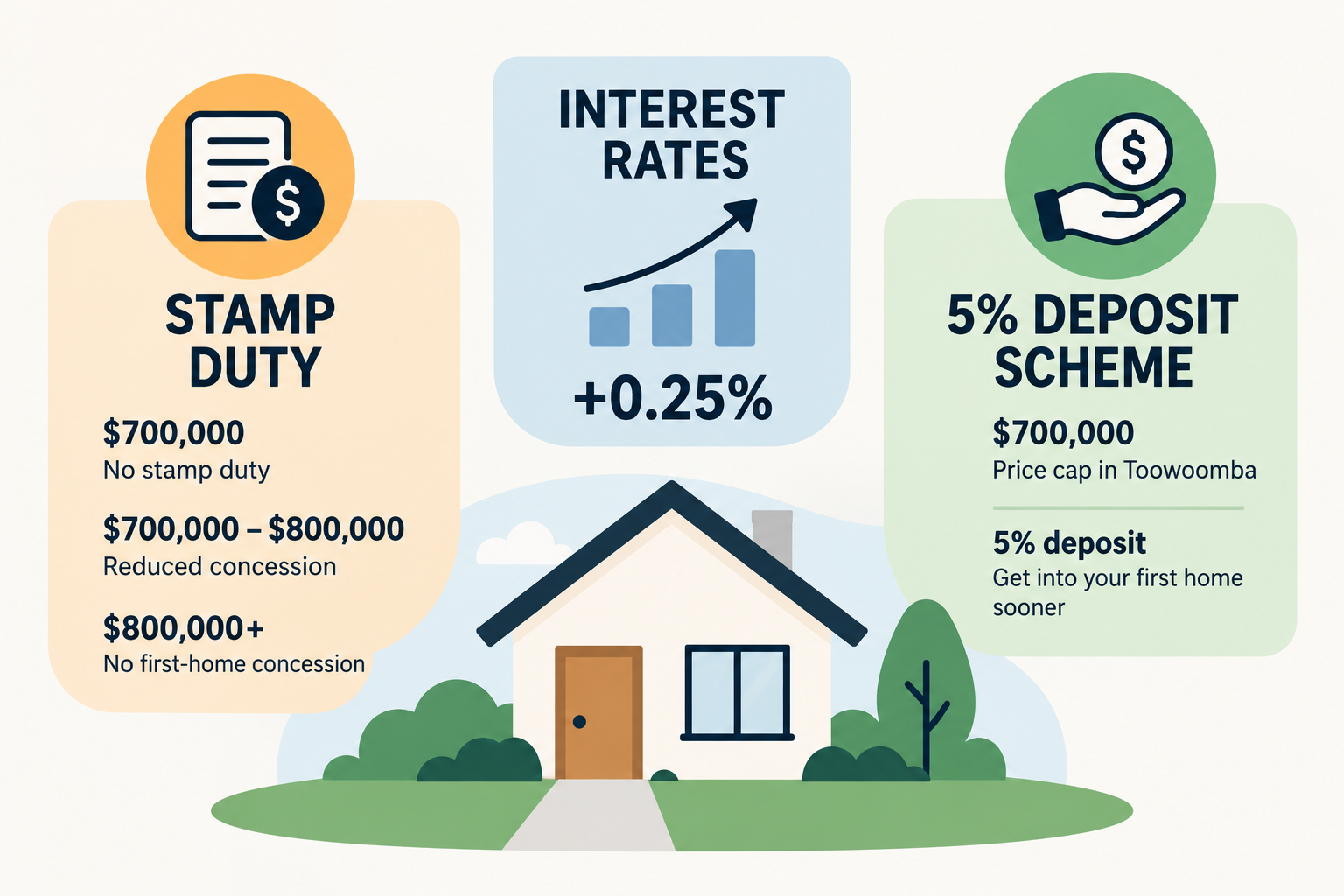
Stamp Duty Savings, Rising Interest Rates and the 5% Deposit Scheme Explained October 2026 | Tomoro Real Estate Buying your first home in Toowoomba is an exciting milestone, but understanding the fin

Sep 14, 2026
Your Guide to the Garden City in Bloom Spring in Toowoomba means one thing: the Garden City is about to burst into colour. The Toowoomba Carnival of Flowers 2026 runs from Friday 18 September to Monda