
What Could It Mean for Interest Rates and Toowoomba Property?
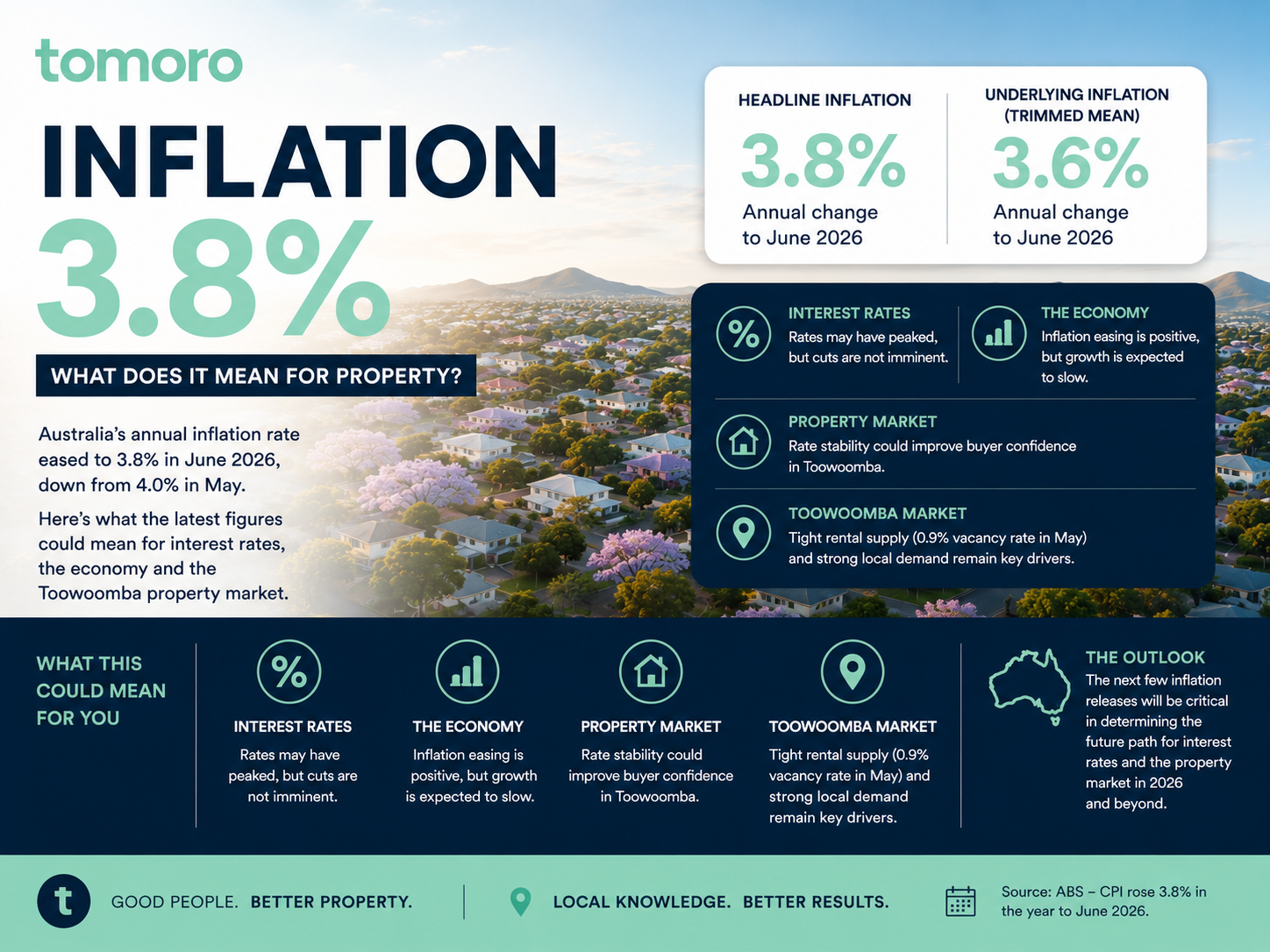
Australia’s latest inflation figures have delivered some encouraging news for households, borrowers and the property market, with annual inflation easing in June 2026.
The Australian Bureau of Statistics reported that the Consumer Price Index rose 3.8% over the 12 months to June 2026, down from 4.0% in May. CPI also fell 0.1% during June itself.
However, underlying inflation remains the number to watch. Trimmed mean inflation was 3.6% annually, still above the Reserve Bank of Australia’s 2–3% inflation target.
So, what could the latest numbers mean for interest rates, the broader economy and, importantly, the Toowoomba property market?
Inflation Is Falling — But the Job Isn’t Finished
The decline in headline inflation from 4.0% to 3.8% is a positive development.
It suggests some of the inflationary pressures affecting Australian households may be beginning to moderate. However, underlying inflation at 3.6% indicates price pressures remain broader and more persistent than the RBA would ideally like.
Housing remains a significant contributor, with housing costs rising 6.8% over the year to June.
For the RBA, the challenge is balancing inflation against the effect higher interest rates are already having on households and businesses.
Further increases could help suppress demand and inflation, but they also increase mortgage repayments, reduce household disposable income and make borrowing more expensive for businesses.
The June result therefore provides the RBA with another reason to assess the impact of previous increases before deciding whether additional tightening is required.
What Happens to Interest Rates Now?
Interest rates are arguably the biggest question for property owners and buyers.
The cash rate currently sits at 4.35%, following three increases during 2026. The June inflation figures do not necessarily mean interest rates will fall soon, but they could reduce the pressure for further increases if inflation continues trending lower.
The key will be underlying inflation.
If trimmed mean inflation begins moving sustainably towards the 2–3% target range, the RBA may eventually have greater flexibility to lower rates.
If underlying inflation remains elevated, rates could stay higher for longer — even if headline CPI continues falling.
For borrowers, therefore, the important development may initially be interest-rate stability rather than interest-rate cuts.
Knowing that rates may be near their peak can improve confidence, even before borrowing costs actually begin falling.
What Does This Mean for the Economy?
Higher interest rates work by reducing demand across the economy.
Mortgage repayments rise, households have less disposable income, businesses face higher financing costs and consumers generally become more cautious.
The RBA is trying to slow demand enough to bring inflation under control without causing an unnecessarily severe economic downturn.
Falling inflation makes that task easier.
If inflation continues moderating, the RBA may be able to maintain rates rather than increase them further, allowing the existing higher-rate environment to continue working through the economy.
For households, lower inflation also matters independently of interest rates. Slower price increases can gradually reduce pressure on household budgets and improve real purchasing power.
What Could It Mean for Property?
For the property market, the June inflation result is potentially positive — but it doesn't automatically mean prices will rise or rates will fall.
Interest rates influence borrowing capacity and mortgage repayments, but property markets are also driven by employment, population growth, housing supply, rental demand, construction activity and consumer confidence.
If inflation continues falling and interest rates stabilise, buyer confidence could improve.
Potential buyers who have been waiting for clarity around rates may begin returning to the market. And if rates eventually fall, borrowing capacity could increase for some households.
Importantly, property markets can react to expectations before the RBA actually changes rates.
If buyers become increasingly confident the next major move in rates will eventually be downward, market behaviour may change well before the first rate cut occurs.
Why Toowoomba Is Worth Watching
The Toowoomba property market has its own supply and demand dynamics that can produce different results from Australia's capital cities.
Despite higher borrowing costs, local property values and rents have remained strong.
Recent market data for the broader Toowoomba region placed the median house price at approximately $841,000 as of May 2026, while the stock-weighted rental vacancy rate was around 0.9%.
A vacancy rate below 1% points to a particularly tight rental market, while limited housing availability can continue supporting rents and investor demand.
Individual suburbs can vary significantly, making property selection increasingly important.
Toowoomba also remains relatively affordable compared with many parts of Brisbane and Australia's larger capital cities, while offering a diversified regional economy and continued infrastructure and population growth.
These local fundamentals mean interest rates are only one part of the Toowoomba property story.
Could Lower Inflation Push More Buyers Into the Market?
Potentially.
Higher rates have reduced borrowing capacity and increased mortgage repayments. If rates stabilise, one major source of uncertainty for buyers begins to disappear.
If rates eventually decline, the effect could become more significant.
Lower mortgage rates generally increase borrowing capacity because a greater proportion of household income can support the loan itself rather than interest repayments.
But there is another side to that equation.
If borrowing capacity increases across thousands of households while housing supply remains constrained, additional purchasing power can translate into greater competition for available property.
That means waiting for lower interest rates does not necessarily result in a cheaper property purchase.
Buyers could potentially obtain cheaper finance but face higher property prices and increased competition.
Should Buyers Wait for Interest Rates to Fall?
There isn't one answer that suits every buyer.
For someone stretching their borrowing capacity or with limited financial buffers, waiting may be appropriate. Higher interest rates need to be factored into affordability carefully.
However, buyers who are financially comfortable at current rates may consider the trade-off involved in waiting.
A future rate cut could improve borrowing capacity, but it could also bring additional buyers into the market.
Instead of trying to predict the exact bottom of the interest-rate cycle, buyers may be better served by concentrating on the factors they can control: purchasing within their means, choosing quality property, understanding local supply and demand, and maintaining an appropriate financial buffer.
What About Property Investors?
Investors face a similar calculation.
Current interest rates mean holding costs are considerably higher than during the ultra-low-rate period. Cash flow and borrowing capacity therefore deserve careful consideration.
But investors generally purchase property based on a much longer timeframe than the next RBA meeting.
For Toowoomba investors, rental demand remains particularly relevant. A tight vacancy rate can support rental income, while constrained housing supply may provide longer-term support for both rents and property values.
The quality of the individual investment remains critical.
Location, land content, property condition, rental appeal, future supply and purchase price can ultimately matter more than attempting to perfectly time an interest-rate cycle.
The Next Few Months Will Be Important
June's inflation result represents progress, but inflation remains above the RBA's target.
The next few CPI releases will help determine whether June marks the beginning of a sustained decline or simply another step in what has been a volatile inflation cycle.
For the property market, the potential transition from rising interest rates to stable interest rates could be significant.
The next transition — from stable rates to falling rates — could have an even greater impact on borrowing capacity and buyer confidence.
For Toowoomba, that could occur against a backdrop of already tight rental conditions and strong property demand.
For buyers and investors, the question may therefore be less about predicting exactly when rates will fall and more about whether the right property, at the right price, fits their financial position today.
This article contains general information only and should not be considered financial, investment or taxation advice.
https://www.rba.gov.au/speeches/2026/sp-gov-2026-07-28.html
You might also be interested in

Sep 14, 2026
Your Guide to the Garden City in Bloom Spring in Toowoomba means one thing: the Garden City is about to burst into colour. The Toowoomba Carnival of Flowers 2026 runs from Friday 18 September to Monda

Jul 19, 2026
Everywhere you look, property investing is marketed as the path to becoming wealthy. Social media is filled with stories of investors building portfolios of ten properties before they're 35. Headlines